
Owens Corning Blown-In Insulation in Chicago: What to Know First
We provide independent Owens Corning blown-in insulation service across Chicago, and most jobs are completed in a single day. Pricing depends on square footage, existing insulation depth, and access, but a typical attic top-up in a Chicago bungalow or two-flat runs $1,800 to $3,400. If you’re a homeowner researching whether to top up, dense-pack, or start fresh with Owens Corning fiberglass or cellulose, this page covers what actually happens on the job and what it costs.
We’re Topside Attic Insulation, and we’ve sealed and insulated 9,000+ Chicago homes since 2016 under The Haven Standard, which means a written price before any work starts and a documented record when the crew leaves. Call (218) 261-7714 for a free estimate.
How Owens Corning Products Fail, and How We Fix Them
Owens Corning blown-in products hold up differently in Chicago than they do in milder climates. Here’s what we find when we open walls and attics in neighborhoods from Portage Park to Hyde Park:
- AttiCat Pink Fiberglas settling in shallow attic cavities: Owens Corning’s AttiCat blown fiberglass is rated to settle less than many competitors, but in Chicago attics with original 1920s framing, we regularly see 40-year-old batts compressed to under R-19 while the homeowner believes they have R-38. The fix is a measured top-up over the existing material after air sealing, not a full removal unless the old insulation is water-damaged or rodent-soiled.
- Propink blown fiberglass bridging over open top plates: Loose-fill fiberglass does not stop air movement. In Chicago balloon-frame homes and two-flats, we frequently find AttiCat or Propink insulation laid neatly over unsealed top plates and can-light housings, which means conditioned air from the living space rises straight through. The insulation looks fine from the hatch. The blower-door number tells a different story.
- Dense-pack cellulose overcompressed in wall cavities: When Owens Corning cellulose is dense-packed above 3.5 pounds per cubic foot, it starts losing R-value per inch and can bulge plaster walls in older Chicago construction. We’ve corrected overpacked walls in frame houses across the Northwest Side where a previous contractor treated every cavity the same. Proper dense-pack is measured by the bag count against cavity volume, not by feel.
- Owens Corning blown-in over wet or rodent-damaged attic floors: Chicago’s freeze-thaw cycles drive moisture into attics in winter, and squirrel or mouse activity in older frame houses soils insulation enough that adding more on top just seals the problem in. We pull back the top layer to inspect before any material goes in. If the existing Owens Corning insulation is compromised, removal and replacement is the honest scope, not a top-up.
- Mixing Owens Corning with aftermarket vent baffles that fail: Many Chicago attic jobs include rafter vent baffles from whatever supplier the installer had on the truck. When baffles are undersized or installed wrong, blown-in Owens Corning fiberglass spills into the soffit and chokes the intake ventilation. On Owens Corning jobs, we use baffles matched to the rafter bay width and staple them before the blower hose ever enters the attic.
Our Owens Corning Blown-In Insulation Process
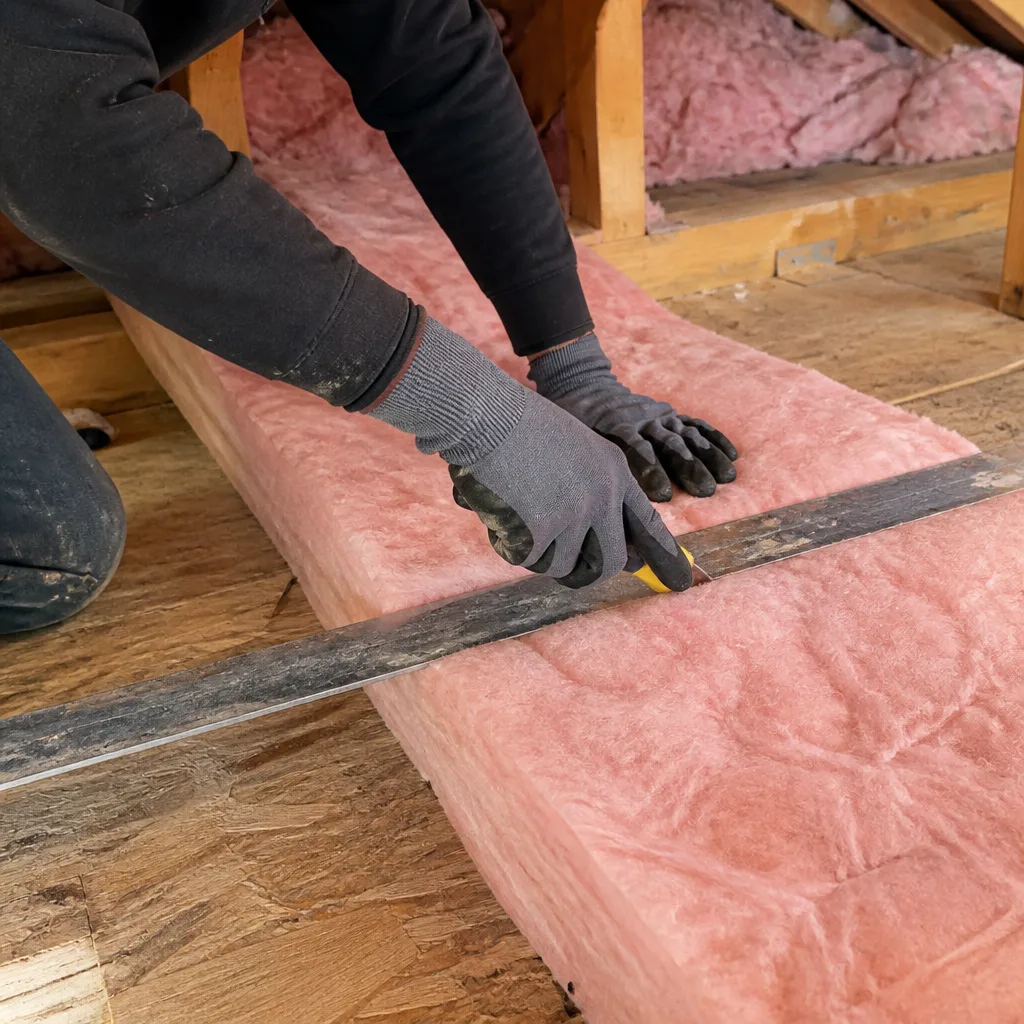
Every Owens Corning job at Topside Attic Insulation follows the same sequence, and you get documentation at each step:
- 1
Written scope and price: Under Haven Standard Clause 1, you receive a flat written price, written scope, and written warranty before anyone lifts a tool. No estimate games, no call-for-pricing.
- 2
Blower-door baseline: Wes Okafor runs a blower-door test before any material is installed. This pressurization reading shows in one number how many cubic feet of outside air your home’s envelope is leaking per minute at 50 pascals. The number is on the report you keep.
- 3
Air sealing first, always: Top plates, can lights, plumbing penetrations, and chase ways are sealed with foam or caulk before insulation goes in. We will not blow Owens Corning material over an unsealed attic floor. Sealing first is not an upsell; it’s the prerequisite.
- 4
Blown-in installation: The chosen Owens Corning product goes in at the specified depth and density, whether that’s a loose-fill attic top-up to R-49 or R-60, or dense-pack in existing wall cavities. Bag counts and installed R-values by zone go on the written report.
- 5
Post-installation blower-door reading: We run the test again when the job is done. You see the pre-installation and post-installation ACH50 numbers side by side. When it works, the numbers show it.
- 6
Documented photo record and closeout: You receive a printed report with pre- and post-installation ACH50, installed R-values by zone, and a photo log of air-sealing locations. Every job closes this way.
As an independent Owens Corning service provider, we’re not tied to a single manufacturer, so the product choice on your job follows the condition of the house, not a supply agreement.
What Owens Corning Blown-In Insulation Costs in Chicago
Here are the ranges we see most often in Chicago homes. These are flat written prices under Haven Standard Clause 1, not ballpark estimates that move after the crew arrives.
- Attic top-up in a standard Chicago bungalow (800-1,200 sq ft attic): $1,800 – $2,600 for air sealing plus blowing Owens Corning AttiCat or Propink fiberglass to R-49.
- Attic top-up in a two-flat or larger frame home (1,200-1,800 sq ft attic): $2,600 – $3,400 for air sealing plus blown-in fiberglass to R-49 or R-60.
- Dense-pack existing walls with Owens Corning cellulose: $2.50 – $4.00 per square foot of wall area, depending on access and whether we’re drilling from inside or outside.
- Full attic removal and replacement (rodent damage or moisture): $4,000 – $7,000 on a typical Chicago attic, including removal, disposal, air sealing, and new blown-in Owens Corning insulation at code depth.
What moves the price: access height, whether the attic has a floor over the joists, the amount of old insulation that needs removal, and how much air sealing the blower-door test reveals. Call (218) 261-7714 for a free estimate and a written price.
Why Chicago Homeowners Call Topside Attic Insulation for Owens Corning Work
Wes Okafor grew up six blocks from the Portage Park field house and studied building technology at Truman College on the North Side, where he learned that air movement and thermal performance are two sides of the same problem. He has been doing insulation work in Chicago for over twenty years, and every job runs through the same discipline: seal the holes first, then add the R-value, and the numbers will tell you whether it worked.
We publish before-and-after blower-door readings on every applicable Owens Corning job, so you can see in one figure what changed. The 365-Day Done Right Promise applies to all completed work, a live person answers the phone 24/7, and if you have a competing written estimate, we’ll read it with you for free. We also work with Johns Manville, Knauf, Rockwool, CertainTeed, Icynene, Demilec, GreenFiber, and Reflectix, so we’re not locked into one manufacturer when the house calls for something specific.
FAQs
Owens Corning’s limited warranty generally covers material defects, not installation errors. If the insulation was installed improperly or air sealing was skipped, the warranty won’t help you and the performance loss is what you’ll feel in January. That’s why we document the installation with bag counts, blower-door readings, and photos on every job. Call (218) 261-7714 for an inspection and we’ll tell you what you’re working with.
If the existing material is dry, uncontaminated, and just under-depth, a top-up is far cheaper than replacement and will run $1,800 to $3,400 on most Chicago attics. Replacement is the honest scope when there’s rodent activity, moisture damage, or the old insulation is compressed beyond usefulness. We’ll tell you which one you need after the inspection, not before.
Most attic top-ups and dense-pack jobs are completed in a single day, including the blower-door before-and-after readings and the photo record. Larger removal-and-replacement jobs may take two days. When you call (218) 261-7714, we’ll give you a schedule with the written price.
For air sealing plus blown-in Owens Corning fiberglass at R-49 depth, Chicago homeowners typically pay $1.50 to $2.25 per square foot of attic floor, depending on access. Wall dense-pack with Owens Corning cellulose runs $2.50 to $4.00 per square foot of wall area. Call (218) 261-7714 for a free estimate and we’ll give you a flat written price before any work starts.
Yes. Chicago’s temperature swings and long heating season mean your attic insulation works harder than in milder climates, and any air leak through the attic floor moves conditioned air out of the house faster. The insulation creates the resistance, but the air sealing is what makes the number on the blower-door test improve. We do both, in that order, every time.
Written by Wes Okafor, Owner & Lead Building Envelope Technician, Topside Attic Insulation at Topside Attic Insulation, serving Chicago and nearby areas.