
Icynene Crawl Space Encapsulation & Vapor Barrier in Chicago: What to Know First
Icynene spray foam in a Chicago crawl space usually fails at the seams, not in the foam itself. We provide independent Icynene crawl space encapsulation and vapor barrier work across Chicago, and most jobs take one to two days once we’ve diagnosed the problem. The honest price posture: a straightforward vapor barrier replacement over an existing Icynene job typically runs $1,800 to $4,200 depending on square footage and access. This page is for homeowners who have Icynene foam in their crawl space and are seeing moisture, odor, or standing water. Call (218) 261-7714 with the square footage and what you’re seeing; we’ll walk you through what’s likely happening before anyone schedules a visit.
How Icynene Products Fail - and How We Fix Them
Icynene makes open-cell and closed-cell spray foam. In Chicago crawl spaces, we mostly see the open-cell formulations: Icynene Classic and Icynene Classic Max. Open-cell foam is an air seal, not a moisture barrier, and that distinction drives most of what goes wrong below a house here.
- Icynene Classic pulling away from the rim joist after freeze-thaw cycles. Open-cell foam absorbs water vapor when the crawl space hits high humidity in July, then the rim joist area freezes in January. The expansion and contraction breaks the bond between foam and wood. In Chicago neighborhoods from Edison Park to Beverly, we regularly find a half-inch gap along the top edge of the foam line where unconditioned air moves through. The fix is cutting back the failed section, addressing the moisture source, and re-foaming the seam with a compatible closed-cell product rated for below-grade contact.
- Mold staining on Icynene Classic Max where it meets the sill plate. Open-cell foam holds water. When a crawl space vapor barrier fails or was never installed, moisture wicks into the foam’s open cell structure. The staining looks bad, but the real problem is the foam’s R-value has dropped. We test with a moisture meter before recommending anything. If the foam reads above 19% moisture content, it needs to come out; if it’s lower, we can often dry the space and encapsulate properly without pulling the foam.
- Rodent tunnels through open-cell Icynene. Mice and rats chew open-cell foam easily. In older Chicago homes with fieldstone foundations, we see Icynene installations that look like Swiss cheese along the foundation wall. Once rodents have tunneled, the foam’s air-sealing value is gone and the material can’t be patched reliably. We remove the damaged sections, address entry points, and re-insulate with a rodent-resistant approach after the crawl space is sealed.
- Icynene foam installed directly against dirt floors. We see this in Chicago bungalows where a previous contractor sprayed foam down the foundation wall and let it contact the soil. The foam wicks ground moisture continuously. By the time we arrive, the bottom six inches of foam are saturated and crumbling. The correct sequence, which we follow every time, is: remove the failed foam, install a proper 12-mil or thicker vapor barrier across the floor and up the walls, then insulate above that line.
- Closed-cell Icynene ProSeal over an unsealed dirt floor. Closed-cell foam is a vapor retarder, but it’s not a replacement for a full vapor barrier. In Chicago’s climate, where the ground stays wet from November through May, ground moisture still moves up around the edges. We find condensation forming on the surface of the ProSeal where it meets the foundation wall. The fix is extending a reinforced vapor barrier across the floor and sealing it to the wall before adding any new insulation. The ProSeal itself is usually still fine; the installation failed around it.
Our Icynene Crawl Space Encapsulation & Vapor Barrier Process
- 1
Site walk and moisture readings. We measure humidity, check foam moisture content with a probe meter, and look for standing water, rodent activity, and foundation cracks. We also look at what’s happening at the exterior grade line, because water against the foundation explains half of what goes wrong inside.
- 2
Written scope and price. You get a flat price, a written scope of work, and a written warranty before anyone lifts a tool. That’s Haven Standard Clause 1, and we’ve done it that way since 2016.
- 3
Prep and protection. We cover any ductwork, seal off the crawl space entry, and set up ventilation or exhaust if we’re pulling old foam. The crew wears respirators and gloves; spray foam removal is not a bare-hands job.
- 4
Removal of failed material. We cut out saturated, rodent-damaged, or delaminated Icynene foam. What’s still bonded and dry stays. We don’t tear out good foam to sell you new foam.
- 5
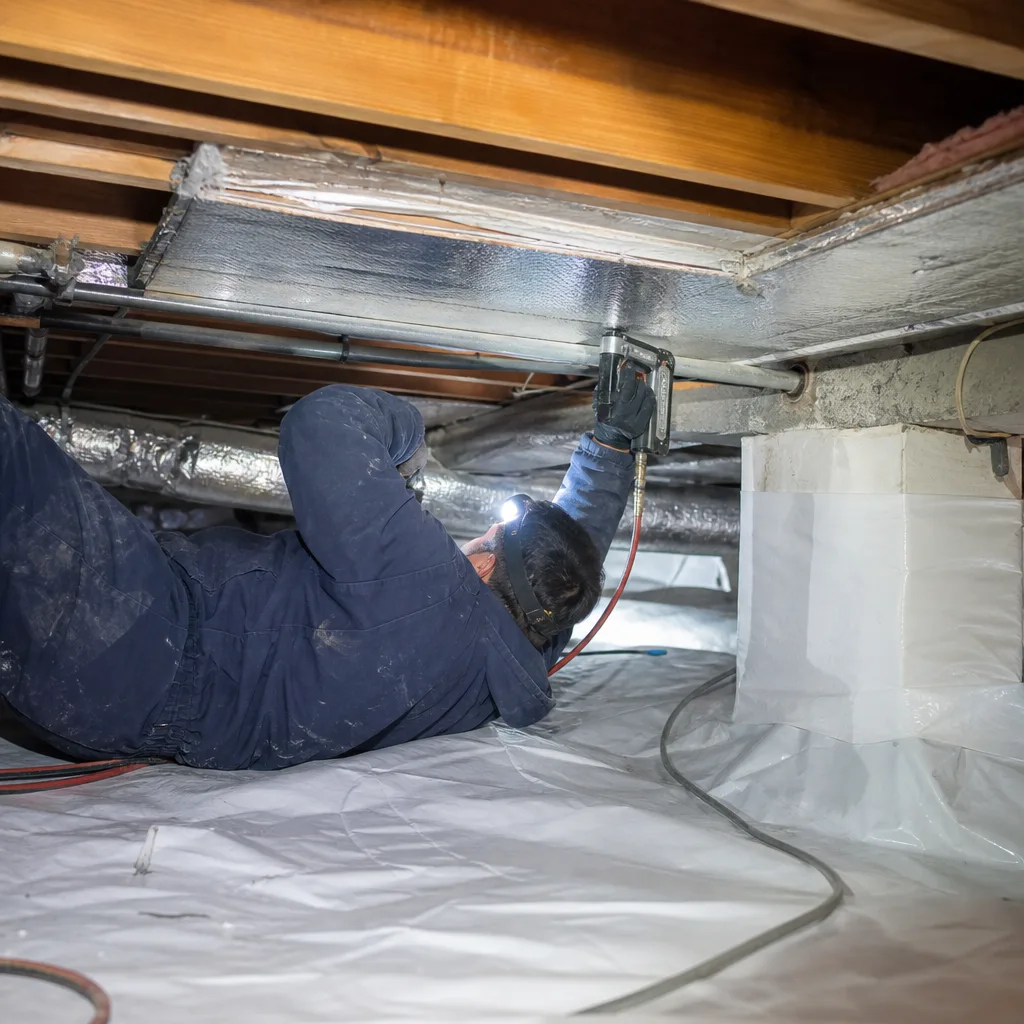
Encapsulation and vapor barrier. A 12-mil or 16-mil reinforced barrier goes down across the floor and up the foundation walls, sealed at every seam and pier with mastic or seam tape rated for below-grade contact. This is the layer that actually controls moisture in a Chicago crawl space.
- 6
Re-insulation at the rim and walls where needed, then documentation. If the rim joist area needs new insulation, we install it after the air sealing is complete and the barrier is in place. You get a Documented Photo Record of every location we touched, plus the scope and warranty in writing.
What Icynene Crawl Space Encapsulation & Vapor Barrier Costs in Chicago
| Scene | Typical cost in Chicago |
|---|---|
| Vapor barrier replacement over existing Icynene (no foam removal), 800-1,200 sq ft | $1,800-$3,400 |
| Full encapsulation: remove saturated open-cell foam, install 12-mil barrier, re-insulate rim joist | $4,200-$7,800 |
| Rodent damage repair: remove and replace damaged Icynene sections plus entry-point sealing | $2,600-$5,500 |
| Moisture remediation: sump pump, drainage, or French drain alongside vapor barrier work | Quoted by written scope, typically adds $1,200-$4,000 |
Square footage, crawl space height, whether foam removal is needed, and whether the space is vented or unvented move the price more than anything else. A 3-foot-tall crawl space with fieldstone walls and 1,500 square feet of floor is a different job than an 800-square-foot modern build with poured concrete. Estimates are free, and the price we give is the price you pay. Call (218) 261-7714 and we’ll schedule a site walk.
Why Chicago Homeowners Call Topside Attic Insulation for Icynene Work
Seal the holes first. Then add the R-value. The numbers will tell you whether it worked. We’ve done Icynene repairs in Chicago long enough to know that most companies want to spray more foam and leave. We don’t. We’re the team that will tell you your foam is fine and your vapor barrier is the problem, because that gets you a long-term fix instead of a repeat visit. Our 365-Day Done Right Promise covers every job, our techs know Icynene’s open-cell and closed-cell lines, and we also service Reflectix radiant barrier installations when a crawl space job calls for it. Since 2016, we’ve done over 9,000 homes, each one with a written price before work started and a documented record when the crew left.
FAQs
If less than 30% of the foam is damaged, repairing is almost always cheaper. If moisture has saturated the foam or rodents have tunneled through more than a third of the installation, full removal and replacement with proper air sealing makes more financial sense than chasing patches. We don’t charge you for an inspection, so you get a straight answer. Call (218) 261-7714 to set one up.
Our calls are answered by a live person, 24/7, and we schedule site walks every week day. We aim for within 48 hours for diagnosis. If there’s standing water or an active leak, we can often prioritize the visit. Text works if you prefer; use the number on this page and send photos of what you’re seeing.
Icynene’s warranty typically covers the foam’s performance when installed per spec. If the original installation was non-compliant, the manufacturer’s warranty may already be void or limited. As an independent Icynene service provider, we’re not authorized by the manufacturer, so we won’t pretend to speak for their warranty department. What we give you is a written warranty on our work, the materials we install, and the installation. Written scope, written warranty, before anything starts.
Open-cell Icynene acts as an air seal, not a vapor barrier. If the crawl space floor is bare dirt or has an old, torn vapor barrier, ground moisture evaporates into the air constantly. The foam doesn’t stop that; it just sits in it and eventually absorbs it. The fix is a proper 12-mil or heavier vapor barrier sealed to the walls. The foam may be perfectly fine. But the moisture path isn’t fully closed.
Written by Wes Okafor, Owner & Lead Building Envelope Technician, Topside Attic Insulation at Topside Attic Insulation, serving Chicago and nearby areas.