
Demilec Attic Insulation: The Chicago Owner’s Guide
Demilec spray foam attic insulation in Chicago typically costs $2,800 to $6,400 to remove and replace in a standard 1,200 to 1,800 square foot attic, and we stock Demilec-compatible open-cell and closed-cell foam on our trucks for same-week installation. Most homeowners discover a problem the same way: energy bills climb through a Chicago winter, a bedroom over the garage never warms up, or a roof inspection turns up foam that has shrunk and pulled away from the rafters. If you bought the home between 2015 and 2022 and it has Demilec foam that’s underperforming, this page covers what actually goes wrong, what it costs to fix, and how we handle it at Topside Attic Insulation
We’re an independent Chicago insulation contractor, not affiliated with Demilec. We install and match their products because certain Demilec formulations like Heatlok HFO and Sealection 500 hold up well in this climate, but we’re not tied to any one manufacturer. If your specific attic needs a different foam chemistry, we’ll tell you that and quote the alternative.
Which Demilec Models This Applies To
Two Demilec product lines account for nearly all the attic work we see in Chicago: the Heatlok HFO series (closed-cell, typically applied to roof decks and underside sheathing in conditioned attics) and the Sealection 500 series (open-cell, used on attic floors in vented attics). The compatibility gotcha is this: Demilec has reformulated Heatlok twice since 2018 to meet blowing-agent regulations. Older Heatlok Soy and Heatlok XT foam from the 2014 to 2018 era does not share the same thermal performance profile or expansion characteristics as current Heatlok HFO Pro. You cannot simply patch old Demilec foam with new Demilec foam and expect a continuous air and thermal barrier.
Identifying what you have is straightforward. Look for the Demilec label on the foam itself or in the mechanical room. If the label is gone, the foam’s texture tells you the family: closed-cell Heatlok is rigid, dense, and dark cream colored, and it resists finger pressure. Open-cell Sealection is soft, pale, and sponge-like. We also note the installation date from the permit record if one exists. Chicago’s building department has required insulation permits for most attic work since 2019, so if your foam went in before then, we may be flying blind on the exact formulation. That matters because we need to know whether a full removal is necessary or a targeted re-application will work.
OEM versus aftermarket is less relevant with spray foam than with mechanical parts. Demilec foam is a chemical system, and the “part” here is the installed material, not a replacement component you can swap. What matters is that the foam we bring meets the same closed-cell or open-cell spec, and that we install it under conditions Demilec’s technical data sheets require, including substrate temperature, humidity, and lift thickness. We document those conditions on every job because skipped steps are why foam fails early in Chicago’s humidity swings.
Signs Your Demilec Attic Insulation Is Failing
- Ice dams forming at the roof edge in winter. This usually means the attic is warmer than it should be, which means either the Demilec foam has pulled away from the roof deck or it was never thick enough to hit the Chicago code minimum of R-49 for attics. Heat leaking through melts snow, and the melt refreezes at the eaves.
- Elevated second-floor temperatures in July and August. Closed-cell Demilec on a roof deck should keep attic heat from radiating down into the living space. If the upstairs runs 10 to 15 degrees hotter than the first floor, the foam’s R-value per inch has likely degraded or the original install was too thin.
- Foam visibly shrinking and pulling away from rafters or sheathing. We see this on Heatlok XT installs from the mid-2010s. Shrinkage of even a quarter inch opens a continuous air gap at every framing member, and a foam seam gap of that size allows more heat loss than most people would believe.
- Musty odor in the attic after a rain. Closed-cell Demilec is also an air barrier and, when installed thick enough, a vapor retarder. If roof sheathing is getting wet and the smell is drifting down, the foam is likely not adhered in places, letting humid outside air contact the deck from above.
- Mice or squirrel activity in the attic. Demilec foam does not attract rodents, but openings around attic penetrations left unsealed before installation give them a highway in. On a failed Demilec job we often find that no air sealing was done before foam was applied, which is exactly the backwards sequence our company refuses to do.
Replacement Cost & What’s Included
For a Chicago attic between 1,200 and 1,800 square feet, full removal of failed Demilec foam and reinstallation of a comparable Demilec-compatible product runs $2,800 to $6,400 installed. Smaller attics under 800 square feet with partial foam failure can run $1,600 to $2,300 for targeted removal and respray. What drives the range: how much foam must be scraped off first (closed-cell removal is slow, labor-heavy work), square footage, roof pitch, and whether the attic is conditioned or vented.
That price includes full removal of failed material, air sealing of top plates, can lights, and every penetration before new foam goes in, the foam itself, and our 365-Day Done Right Promise on all completed work. Under Haven Standard Clause 1, you get a flat written price with a written scope and written warranty before anyone lifts a tool. No surprises at the end, and no hidden line items for disposal or fuel. Before and after blower-door readings are included on every Demilec replacement job, so you see the actual CFM50 and ACH50 change in writing.
DIY or Call Us?
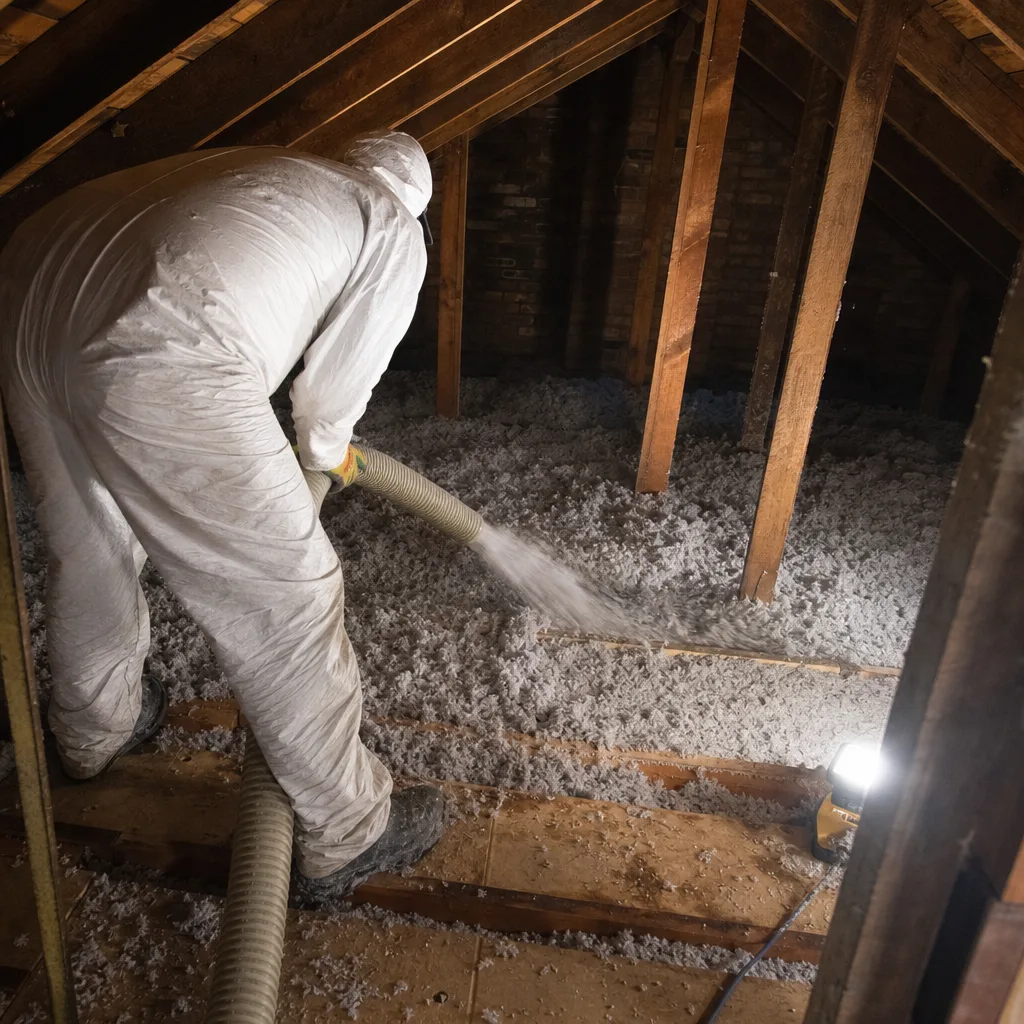
There is no realistic DIY path for Demilec foam repair. The chemicals are two-component isocyanate and polyol blends. The isocyanate side is a respiratory sensitizer and skin irritant, and improper mixing creates foam that off-gasses and underperforms. Spray foam application requires a proportioner, proper PPE including supplied air, and substrate preparation you can’t see from the outside. This is not a weekend project, and we’re not going to soften that to sound polite.
What an owner can safely do is inspect from the attic hatch: look for visible shrinkage at framing seams, run a hand over the foam to check for brittleness or dusting, and note any spots where daylight or outside air is getting through around vents and penetrations. Take photos with your phone, mark locations, and bring those to us. If you want a documented look before deciding anything, call (218) 261-7714 and we’ll schedule a site visit with blower-door testing. The numbers will tell you whether the foam actually needs to come out or whether you have a different problem entirely, like missing air sealing at the rim joist.
FAQs
Demilec closed-cell foam, installed correctly and protected from UV exposure, lasts 30 to 50 years in a Chicago attic, while open-cell Sealection lasts about 20 to 30 years. The qualifier is “installed correctly.” We’ve pulled failing Demilec foam out of attics that was only 8 years old because the substrate was too cold during application or the installer skipped air sealing first. If your foam is under 10 years old and failing, the original install is the problem, not the product. Call (218) 261-7714 and we’ll run a blower-door test to see what’s actually happening before anyone quotes removal.
Small areas of pull-away or thin spots under 10 square feet can sometimes be re-sprayed, but only if the existing foam is a current-formulation product and still well-adhered everywhere else. Most Demilec failures we see in Chicago are widespread shrinkage, which means full removal and reinstallation is the only fix that restores a continuous air and thermal barrier. We’ll tell you which situation you have after an inspection, and we’ll show you the photos and the blower-door numbers to back up that call.
A full removal and respray for a typical Chicago attic takes 2 to 3 working days, including foam removal, air sealing, application, and the post-installation blower-door test. Open-cell floor applications can sometimes be done in 2 days. We schedule a named technician, text you when we’re on the way, and you get a Documented Photo Record of every visit, not just the finished job.
Yes. We keep Demilec Heatlok HFO Pro and Sealection 500 component sets in our Chicago warehouse, and we carry open-cell stock from other brands including Owens Corning, Johns Manville, and Icynene, plus Reflectix radiant barrier for vented attics, so we’re not locked into one manufacturer’s lead times. That means we can typically start a Demilec replacement within a week of your written estimate. Call (218) 261-7714 for a free estimate and a written price before any work starts.
Written by Wes Okafor, Owner & Lead Building Envelope Technician, Topside Attic Insulation at Topside Attic Insulation, serving Chicago and nearby areas.