
Attic Insulation What It Really Costs: What Chicago Homeowners Pay in 2026
Most attic insulation jobs in Chicago run between $2,400 and $6,800 in 2026, with the typical 1,200 to 1,600 square foot attic landing around $3,200 to $4,900 when air sealing is included. The number that matters most is not the square footage price, it’s whether the quote covers sealing the attic floor before insulation goes in. If you’d rather not spend your Saturday crawling through fiberglass, call Topside Attic Insulation at (218) 261-7714 and we’ll give you a written price before any work starts.
Two homeowners on the same block in Portage Park, same 1,400-square-foot attic, same R-49 target: one pays $1,900, one pays $4,100. The difference is not markup. It’s that the $1,900 quote skips the air-sealing labor that determines whether the insulation performs at all. Here’s how to read the quotes you’re getting.
Why Two Chicago Quotes for the Same Attic Are $2,000 Apart
The reason Chicago homeowners get wildly different attic insulation quotes for the same square footage is that contractors are not pricing the same scope. One quote includes air sealing, another does not, and neither document explains which. You’re comparing a sealed-and-insulated job to a blow-and-go job, and the paperwork rarely makes that obvious.
Here’s what the two quotes actually include:
- The $1,900 quote: blown-in fiberglass or cellulose to R-49, no air sealing, no blower-door test, one crew, half a day, done by noon.
- The $4,100 quote: blower-door diagnostic to locate bypasses, air sealing of top plates, can lights, plumbing chases, and the attic hatch, then insulation to R-49, with before-and-after blower-door numbers in writing.
The $2,200 spread is mostly labor hours spent sealing penetrations you cannot see and will never photograph well. But those penetrations are where your conditioned air leaves the house all winter. In a city where January lows average 18°F, that is not a rounding error. We publish before-and-after blower-door numbers on every applicable job because a single figure should tell you what changed: 4,200 CFM50 before sealing, 2,100 after means we cut the air leakage in half before the first bag of insulation was opened.
How Much Does Attic Insulation Cost in Chicago in 2026? A Line-Item Breakdown
Attic insulation pricing in Chicago breaks into three non-negotiable line items. If a contractor cannot separate these for you in writing, you are not getting a real scope, you are getting a number.
1. Diagnostic blower-door test: $250 to $450. This is a pressurization measurement that shows, in one number, how much air your building envelope is losing. It is run before work to locate bypasses and after work to verify the sealing result. Some contractors skip it entirely. Others run it only after. Insist on before-and-after readings.
2. Air sealing labor and materials: $800 to $2,800. This is the line item that swings the most. Attic bypasses vary by house age and construction type. A 1920s Chicago bungalow with balloon framing has gaps a 2015 two-flat will not. The labor to seal top plates, can lights, plumbing chases, and attic hatches in a standard Chicago two-flat can run from $800 on a clean, accessible attic to $2,000 or more when the framing is tight or the original construction left open wall cavities. This is the part the $1,900 quote leaves out.
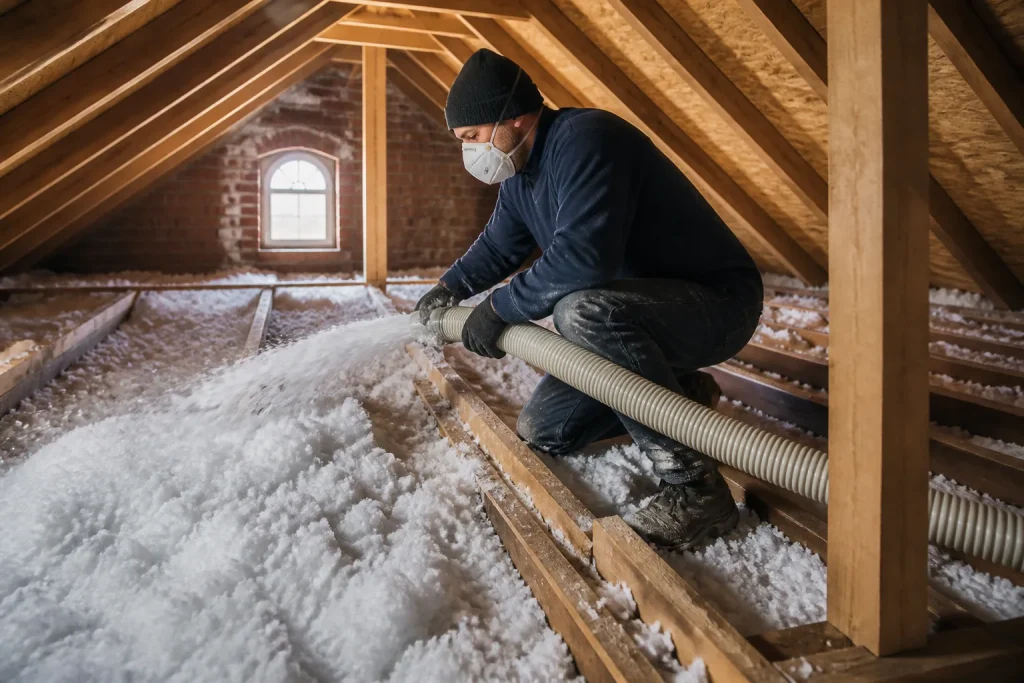
3. Insulation installation: $1,100 to $3,500, depending on material, depth, and square footage. Blown-in fiberglass to R-49 runs roughly $1.40 to $1.90 per square foot installed. Cellulose runs $1.20 to $1.70. Rockwool batts cost more but hold their R-value in Chicago’s humidity swings and are often worth the premium if you store anything in the attic.
Quotes priced per square foot of blown insulation alone are structurally incomplete because they assume the attic floor is ready for insulation. In Chicago homes built before 1980, it almost never is. The bypasses get sealed first, then the insulation goes in, in that order. Attic insulation in Chicago priced without sealing is pricing a product that cannot reach its rated performance.
What a Written Price Should Include in Chicago
A verbal estimate is a guess with a handshake. A written price is a document you can hold a contractor to. Under the Haven Standard, we hand you a written price before anyone lifts a tool, and no work starts without it. No exceptions, since 2016.
Here’s the checklist to demand in writing from any Chicago insulation contractor:
- Scope of air-sealing penetrations identified: top plates, can lights, plumbing chases, attic hatch weatherstripping, any visible bypasses. If the word “sealing” does not appear, it is not in the job.
- Target ACH50 post-install: air changes per hour at 50 pascals of pressure. This is the number the blower door reports. A post-seal target of 4.0 to 6.0 ACH50 is reasonable for older Chicago stock; new construction should beat 3.0.
- Material type and installed depth: R-49 in Chicago means roughly 16 to 18 inches of blown fiberglass or 14 to 16 inches of cellulose, depending on settled density. If the quote does not state the material brand and installed depth, you cannot verify the R-value from the attic floor.
- Warranty terms: what is covered, for how long, and what the contractor will actually do if the insulation settles below spec or the sealing fails. We back completed work with the 365-Day Done Right Promise: if it’s not done right, we make it right.
We pulled one out of a garage over in Beverly last month where the homeowner had a quote for $2,100 that listed “insulation” and nothing else. No sealing, no blower door, no material name, no depth. When we ran the diagnostic, the attic hatch alone was leaking the equivalent of leaving a bedroom window cracked open from October through April. That single gap, sealed with $60 of weatherstripping and foam, was worth more than half the insulation’s performance. The quote never mentioned it because nobody had looked.
Rebates and Incentives: The Illinois HOMES Act and ComEd/Nicor in 2026
Illinois homeowners in 2026 can offset attic insulation and air-sealing costs through the Illinois HOMES Act, which provides rebates for whole-home energy improvements, and through ComEd and Nicor Gas efficiency programs that cover part of insulation and air-sealing upgrades under income-qualified and standard pathways. The exact rebate amount depends on the improvement type, the post-work verification results, and household income.
Here is what most Chicago contractors will not tell you up front: the rebate is tied to documentation. You need a pre-work diagnostic, a post-work blower-door or equivalent verification reading, and an invoice that itemizes the improvements so the rebate processor can match the work to the program’s approved measure codes. A quote that says “insulation” does not survive rebate review. A written scope that separates sealing from insulation does.
Ask your contractor for the specific forms before you sign. If they cannot name the ComEd or Nicor program you qualify for and tell you which documentation they will provide, the rebate is not guaranteed, it is hypothetical. We provide the before-and-after blower-door readings and an itemized invoice on every job precisely so the rebate paperwork has teeth.
The Cost of Skipping Air Sealing: What It Actually Adds Up To
Insulation installed over unsealed bypasses in a Chicago home does not fail all at once. It underperforms quietly, every month, on the gas bill and the electric bill. Here is a representative scenario based on jobs we have measured:
A 1,400-square-foot brick two-flat in Irving Park, built 1948, original blown insulation settled to R-19 in spots. Blower door reads 4,200 CFM50 before any work. If the attic is insulated to R-49 without sealing, post-work leakage might drop to 3,400 CFM50, a 19 percent reduction. If the same attic is sealed first, then insulated to R-49, leakage drops to 2,100 CFM50, a 50 percent reduction.
That difference, 1,300 CFM50 of conditioned air leaking out, at Chicago’s natural gas rates and roughly 6,500 annual heating degree days, translates to about $210 to $340 per year in extra heating cost and a larger penalty in summer when the AC runs against the same stack effect in reverse. Over a decade, the unsealed job costs the homeowner an extra $2,100 to $3,400 in utility payments, on top of the $1,900 they already spent. The cheaper quote was never cheaper.
If you need a hand figuring out how your attic stacks up, spray foam insulation in Chicago is one path for tight or irregular attics, and we walk every homeowner through the options with a written price before any decision gets made.
When to Call a Professional
You can inspect an attic yourself. You can measure settled depth with a yardstick. You should not cut into ceiling drywall to chase a plumbing chase, and you should not attempt to seal or remove insulation around old can lights without knowing whether they are IC-rated. Fiberglass does not bite, but attics in July hit 130°F, and the framing is not always where it looks like it is from the hatch. If the job involves removing old insulation, sealing around electrical, or working in a low-pitch attic with no decking, call someone who does this every day.
And if you have a written estimate from another Chicago contractor that lists insulation only, with no sealing line, bring it to us. We will read it with you. That is the Free Second Opinion on Any Written Estimate, and it costs you nothing.
Key Takeaways
- Attic insulation in Chicago runs $2,400 to $6,800 in 2026; most 1,200 to 1,600 square foot attics land between $3,200 and $4,900 with air sealing included.
- Three line items make up the real cost: diagnostic blower-door test ($250-$450), air sealing ($800-$2,800), and insulation installation ($1,100-$3,500).
- The $2,000 spread between quotes for the same attic is almost always air-sealing labor that the cheaper quote omits.
- Illinois HOMES Act and ComEd/Nicor rebates require itemized documentation; a quote that says “insulation” will not survive rebate review.
- Skipping air sealing costs an extra $210-$340 per year in heating alone on a typical Chicago two-flat. Over a decade, that is more than the sealing would have cost in the first place.
We know that’s a lot of numbers, but that’s the point: the price you pay for attic insulation in Chicago should be built from numbers you can verify, not a single line on a form. If you have a quote in hand that does not separate sealing from insulation, or you want a written price that lists every penetration we will seal and the target ACH50 we will hit, call us at (218) 261-7714. We provide free estimates, and every estimate comes in writing before any work begins.
The Bottom Line
Attic insulation in Chicago is not a commodity, it is a system. The insulation only performs if the attic floor is sealed first, and the only way to verify that is with before-and-after blower-door numbers in writing. Most of the pricing chasm between quotes comes down to whether the contractor is sealing penetrations or skipping them, and the cheapest number on the page is often the one that will cost you hundreds annually in leaked air.
If you’re in Chicago and need help, Topside Attic Insulation offers free estimates with a written price before any work starts. Call (218) 261-7714 or ask us about crawl space encapsulation and vapor barrier work in Chicago if the air leaks are coming from below. We have sealed and insulated over 9,000 homes since 2016, each one documented when the crew left.
Frequently Asked Questions
Most attic insulation jobs in Chicago run between $2,400 and $6,800 in 2026, depending on attic size, material choice, and whether air sealing is included. A typical 1,200 to 1,600 square foot attic with air sealing and blown-in insulation to R-49 lands between $3,200 and $4,900. Call (218) 261-7714 for a written price on your specific attic, estimates are free.
Yes. Air sealing closes the bypasses that let conditioned air escape through the attic floor, and insulation does not stop moving air. Insulating over an unsealed attic in Chicago typically leaves 50 percent of the air leakage intact, costing $210 to $340 more per year in heating. Sealing first, then insulating, is the order that makes the insulation perform. Call (218) 261-7714 if you want a blower-door reading to see where your attic leaks.
Illinois homeowners can access rebates through the Illinois HOMES Act and through ComEd and Nicor Gas energy-efficiency programs, which cover part of insulation and air-sealing costs. You need a pre-work diagnostic, a post-work verification reading, and an itemized invoice to claim them. Ask any contractor for the specific forms before you sign. Call (218) 261-7714 and we’ll tell you which programs apply to your house and what documentation you’ll receive.
You can rent a blower and add insulation to an accessible attic, but you cannot run a blower-door test, seal hidden bypasses, or verify the air-sealing result without specialized equipment. Most DIY insulation jobs skip the sealing step entirely, which means you pay for the materials and still lose the performance. If you are set on doing part of it, the inspection is the part you can do safely. The sealing is the part that pays for itself. Call (218) 261-7714 for a free estimate and we’ll show you exactly what needs sealing before you decide.
Written by Wes Okafor, Owner at Topside Attic Insulation, serving Chicago since 2016.
Need Insulation Help?
Call Topside Attic Insulation - licensed & insured, here with fast after-hours help in Glendale.
(218) 261-7714