
GreenFiber Attic Insulation in Chicago: A Homeowner’s Guide
A Chicago attic insulated to R-49 with fiberglass batts can lose 30 to 40 percent of its effective R-value in January, when stack-effect air movement channels through the unbonded fibers. GreenFiber blown cellulose closes those channels through settled density, a metric the batt’s label never accounts for. The material earns its reputation here not because it’s made from recycled newsprint, but because of how it behaves during a Chicago freeze-thaw cycle. If you’d rather not sort through the details yourself, call (218) 261-7714 and we’ll walk you through what your attic actually needs.
We’re Topside Attic Insulation, and we’ve been sealing and insulating Chicago attics since 2016. This guide covers what GreenFiber does well, where it falls short if installed wrong, and what the performance numbers look like before and after a proper install.
What GreenFiber Actually Is, and Why Chicago Installers Use It
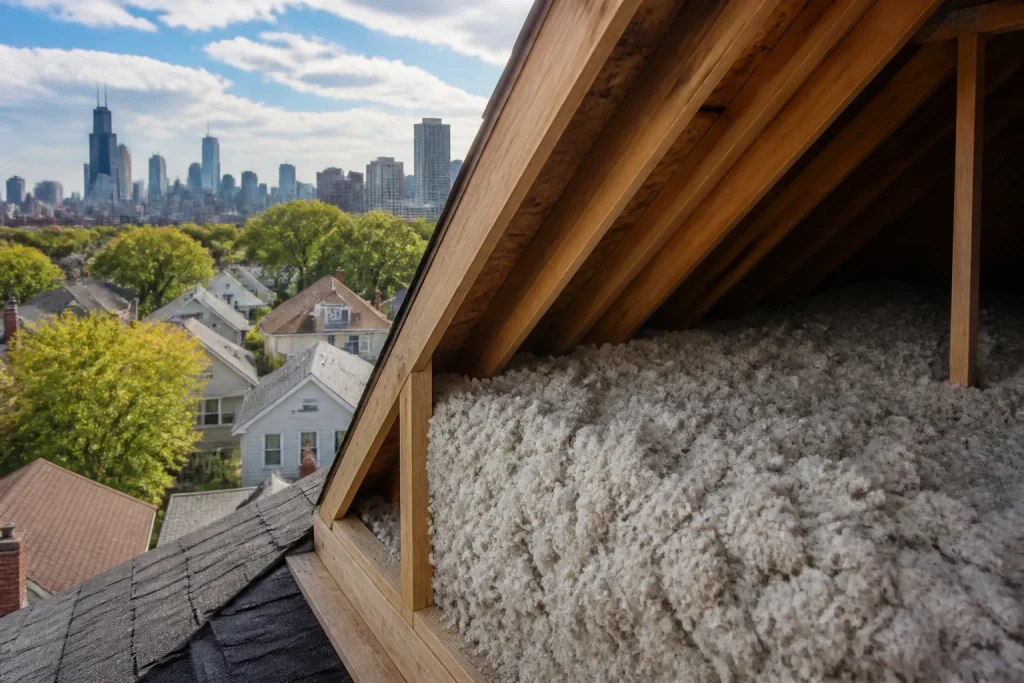
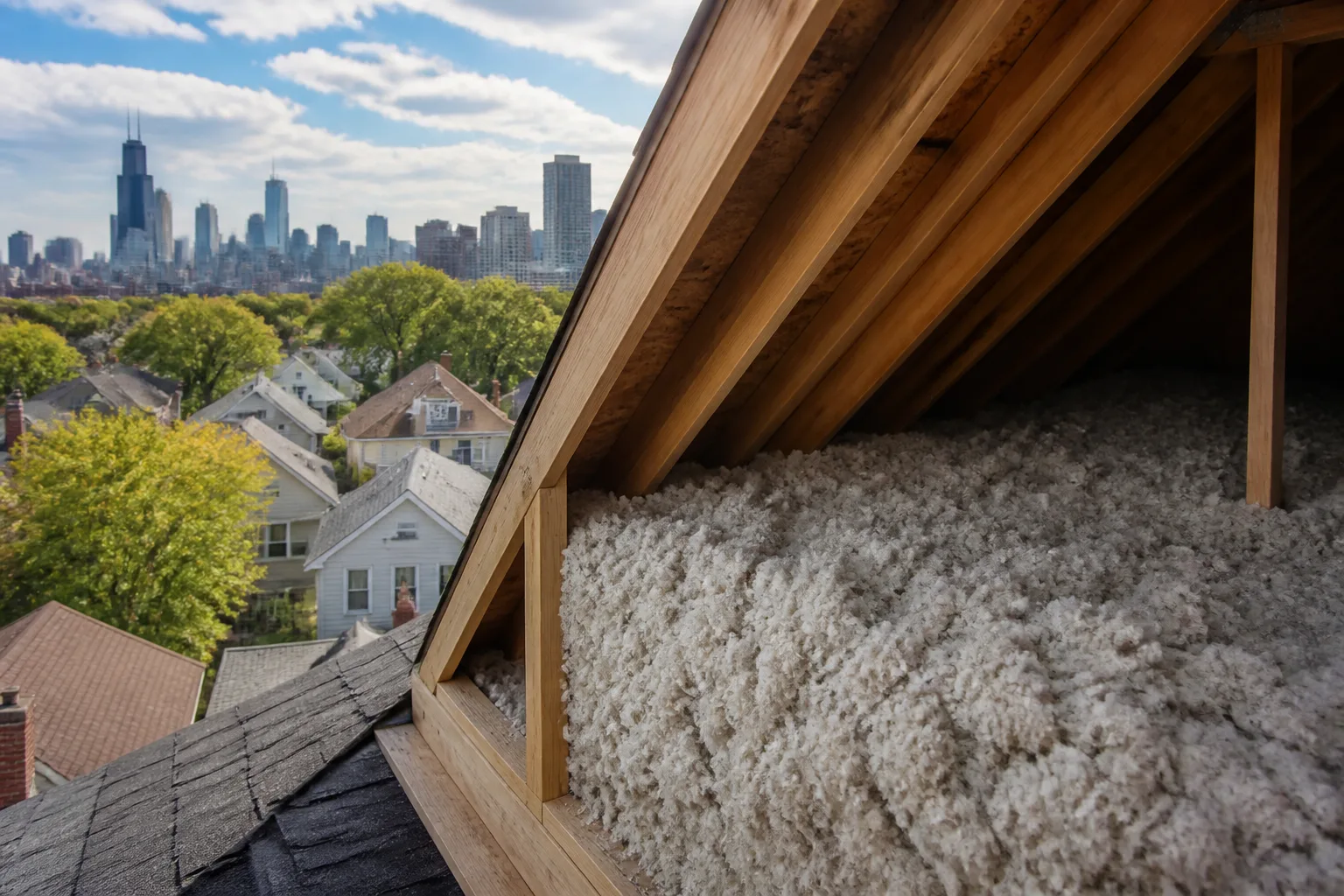
GreenFiber is blown cellulose insulation. The material is shredded recycled paper treated with borates for fire resistance and pest deterrence, then chopped fine enough to flow through a hose at hundreds of pounds per hour. Installers blow it loose over attic floors or dense-pack it into wall cavities. In Chicago attics, the loose-fill application is the standard.
What separates GreenFiber from loose-fill fiberglass is how it settles. GreenFiber publishes settled-density figures in pounds per cubic foot. That number matters because settled density determines how much air can move through the material. Air movement is the enemy of insulation performance. A material that traps air in small pockets resists heat transfer well. A material with open channels lets conditioned air slip right through.
Fiberglass blown or batted into an attic has a lower settled density and lets stack-effect air pressure from the heated rooms below push through it. GreenFiber’s higher settled density, confirmed by the bag count and depth ruler during install, closes those channels. In a city that records over 6,500 heating degree days a year, density is the metric that pays for itself.
Settled Density: The Number More Important Than Depth
Chicago’s heating season is long and aggressive. Heat rises, pushes against the attic floor, and finds any opening. Insulation that slows that movement keeps heat in the living space. Insulation that has gaps, seams, or open fiber structure lets the heat bleed through.
GreenFiber publishes its settled density at 1.8 to 2.0 pounds per cubic foot for attic loose-fill. We check that figure on every GreenFiber job by logging the number of bags used against the square footage and the final installed depth. A 1,000-square-foot attic at R-49 needs roughly 63 to 67 bags of GreenFiber, depending on existing insulation and ceiling framing. The depth ruler photos we take at the end of the job document that the material went in at the specified depth. The bag count documents that the material went in at the specified density.
Depth alone doesn’t tell the full story. You can blow any insulation to 16 inches and still get poor performance if the material is too air-permeable. Density, not depth, is what resists stack-effect air movement in a Chicago winter. When we run a blower-door test before and after a GreenFiber install, the before number often reads between 4,000 and 5,500 CFM50 for a typical 1920s through 1990s Chicago home. After air sealing and insulation, that figure commonly falls to 2,000 to 2,800 CFM50. You can see the change in a single figure, printed on the documentation we leave with you.
The Air-Sealing Prerequisite Most Quotes Skip
GreenFiber does not solve air leaks. It slows them. If your attic floor has open top plates, unsealed can-light penetrations, or plumbing chases dumping conditioned air into the attic, that air bypasses the insulation entirely. Blowing GreenFiber over those openings means your heated air still escapes, just through a thicker layer first.
A blower-door test before the insulation goes in identifies those bypasses. The test pressurizes the house and measures, in CFM50, how much air the building envelope is losing. We don’t insulate attics over unsealed floors. In Chicago, top-plate gaps at exterior walls are the most common bypass we find, along with recessed-light housings from remodels and holes where bathroom fans vent into the attic instead of through the roof.
Seal first, then insulate. The order matters. Once the bypasses are sealed with foam or caulk, the GreenFiber goes in and its settled density does the rest. Any Chicago contractor who quotes GreenFiber without including air sealing is quoting half a job.
This is the difference we built our approach around. Topside Attic Insulation treats air sealing as a prerequisite, not an upsell. If a competitor’s quote omits air sealing, bring it to us. We’ll read it with you and show you where the gaps are. That’s a free second opinion, and it’s part of how we’ve operated since 2016.
Freeze-Thaw, Moisture, and Chicago’s Climate Zone 5
Chicago sits in Climate Zone 5. That means cold winters, warm humid summers, and a real condensation risk at the attic floor when warm indoor air meets cold surfaces. The insulation material you choose has to handle moisture without losing performance.
GreenFiber is hygroscopic. It absorbs moisture vapor and releases it as conditions change, without breaking down or losing insulating performance. That matters in a Chicago attic because winter condensation events are routine. When warm air leaks through a bypass, it carries moisture. At the dew point inside the attic assembly, that moisture condenses.
Fiberglass doesn’t absorb moisture. It lets condensation form on the fibers and drip onto drywall or framing. We’ve pulled moldy, water-stained fiberglass out of attics in Beverly and Edison Park where a bathroom fan had been dumping warm moist air straight into the insulation for years. GreenFiber isn’t immune to bulk water, nothing is. But its hygroscopic behavior gives it a margin in the vapor management department that fiberglass doesn’t have.
That doesn’t mean GreenFiber solves moisture problems. The solution is air sealing the bypass first. The material just handles what slips through better than the alternative.
What a GreenFiber Install in Chicago Costs, Including What Most Quotes Leave Out
Here are real numbers. For a typical 1,000 to 1,500-square-foot attic in Chicago, a GreenFiber install to R-49 runs between $2,800 and $5,200. That includes air sealing of top plates, can lights, and accessible penetrations. The material alone is $1.10 to $1.60 per square foot. Air sealing adds $900 to $1,800 depending on how many bypasses we find. The blower-door test before and after is part of the job, not a line item we add on later.
When you see a quote for GreenFiber that’s well under $2.50 per square foot total, ask what’s missing. Usually it’s the air sealing. Sometimes it’s the density. A contractor running light on bags per square foot gets lower material cost and a lower settled density, and you get an R-value that doesn’t hold up in January. Ask for a bag-count log and a settled-density statement in writing. We provide both on every GreenFiber job, along with depth-ruler photos and the blower-door readings.
Under the Haven Standard, every job starts with a written price. You get a flat number, a written scope, and a written warranty before anyone lifts a tool. No estimate padding, no surprise change orders. Attic insulation in Chicago gets quoted this way or it doesn’t get quoted by us at all.
What You Receive When the Crew Leaves
Documentation is where we think most contractors under-deliver. You shouldn’t have to ask for proof the work was done. You should receive it without asking.
On every GreenFiber job, you get:
- Depth ruler photos showing the installed depth at multiple points across the attic
- Bag-count log recording exactly how many bags of GreenFiber went in, matched against square footage
- Before-and-after blower-door numbers, printed with the CFM50 readings from both tests
- Documented photo record of the air sealing work and the completed install
- Written scope and warranty matching the written price you approved before work started
One job we did last winter in Irving Park had a blower-door reading of 5,100 CFM50 before we started. The attic had fiberglass batts at R-30, badly settled in spots, with unsealed top plates along every exterior wall. After sealing those bypasses and blowing GreenFiber to R-49, the retest read 2,400 CFM50. The homeowner has those numbers in hand, on paper. That’s the record that matters, not a sales pitch.
Our name, Topside Attic Insulation, comes from the building envelope. That’s the layer between inside and out. When it’s sealed and insulated correctly, you know it by the numbers, not by how warm it feels on a windy day.
When to Call a Pro
Insulation work itself is not the dangerous part of an attic job, but the conditions around it can be. If your attic has vermiculite insulation, knob-and-tube wiring, or signs of animal activity, stop and get a professional evaluation before anyone starts blowing material. If your attic smells musty or shows water staining on the roof deck, the moisture problem has to be addressed before insulation can go in. And if you’re not comfortable identifying bypasses, the blower-door test will find them for you.
Related services we handle in Chicago: crawl space encapsulation and vapor barriers, spray foam insulation, insulation removal and replacement, and full home energy audits. Each one starts with a written price and ends with documented proof.
The Bottom Line
GreenFiber is the right material for many Chicago attics, but only when its settled density is installed over a sealed attic floor. The material’s recycled-content story is fine. The performance story is better. Six-thousand-plus heating degree days a year means Chicago attics need density, not just depth. Before-and-after blower-door numbers show whether the job worked. Ours do. Every time.
If you’re in Chicago and want a written price for GreenFiber attic insulation with air sealing included, call (218) 261-7714. The estimate is free, the scope is written, and the documentation comes with the work.
Frequently Asked Questions
For a typical 1,000 to 1,500-square-foot Chicago attic, GreenFiber installed to R-49 with air sealing included runs between $2,800 and $5,200. Material alone is $1.10 to $1.60 per square foot. Air sealing adds $900 to $1,800 depending on bypass count. Call (218) 261-7714 for a written price on your specific attic.
For Chicago’s freeze-thaw climate, GreenFiber’s settled density of roughly 1.8 to 2.0 pounds per cubic foot resists stack-effect air movement better than fiberglass batts or loose-fill. Its hygroscopic behavior also manages condensation vapor better in a Climate Zone 5 assembly. Neither material solves air leaks on its own.
Yes, and that’s the problem. Blowing GreenFiber over unsealed bypasses like top-plate gaps and can-light penetrations means conditioned air still escapes. A blower-door test identifies those bypasses before installation. Any Chicago contractor quoting GreenFiber without air sealing is omitting the step that makes the insulation perform.
A live person answers our phones 24/7. We’ll schedule your blower-door test and the install as soon as our schedule allows. You’ll get a text with the technician’s name before they arrive, under the Haven Standard. Call (218) 261-7714.
Written by Wes Okafor, Owner at Topside Attic Insulation, serving Chicago since 2016.
Need Insulation Help?
Call Topside Attic Insulation - licensed & insured, here with fast after-hours help in Glendale.
(218) 261-7714