
GreenFiber Spray Foam Insulation in Chicago: What to Know First
GreenFiber spray foam insulation in Chicago typically costs $2,800 to $7,400 for a full attic application in a 1,400-square-foot home, and most jobs run one to two days from initial blower-door test to final reading. We provide independent GreenFiber service, meaning we work on homes where GreenFiber products are already installed or where homeowners want them added, without being tied to the manufacturer. If you own a Chicago home built or renovated with GreenFiber cellulose or spray-applied products and now need the air-sealing and thermal performance verified or repaired, this page covers what actually goes wrong, what it costs to fix, and how we document the result. Call (218) 261-7714 to schedule a written estimate – no work starts without one.
This page is for homeowners in Chicago neighborhoods like Portage Park, Irving Park, Jefferson Park, Norwood Park, and the near northwest suburbs who inherited a GreenFiber installation from a previous owner or a building contractor and want to know if it was done right. We have been testing and correcting building envelopes since 2016, and the failures we see in Chicago have a pattern: insulation installed before air sealing, and no pressure test before or after. We fix that order.
How GreenFiber Products Fail and How We Fix Them
GreenFiber makes dense-pack cellulose, loose-fill cellulose, and stabilized spray-applied cellulose, along with a spray foam line. In Chicago, the most common failure we see is not the material itself – it is the absence of air sealing before the material went in. Here are five GreenFiber-specific failure modes we encounter regularly:
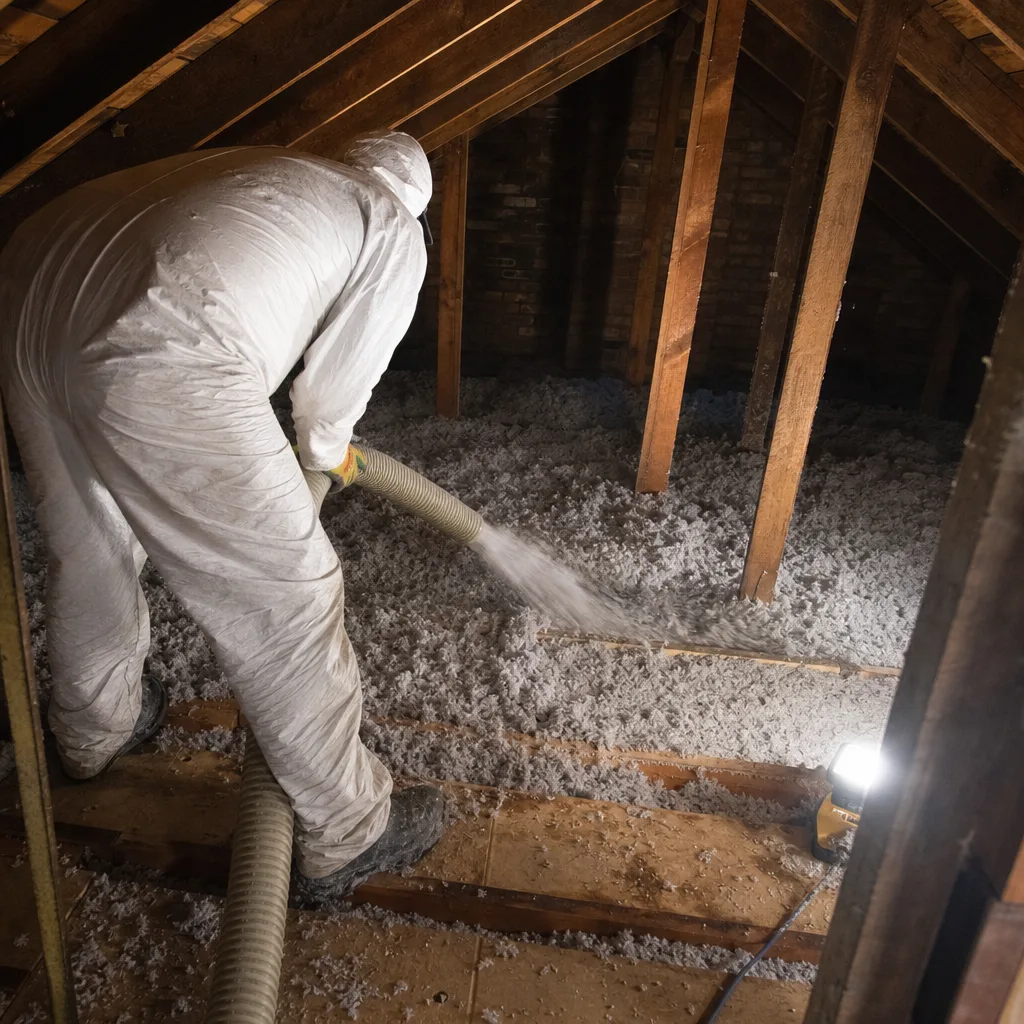
- GreenFiber Sanctuary loose-fill over an unsealed attic floor. The cellulose gets blown over can lights, top plates, and plumbing penetrations without any foam or caulk sealing those gaps first. Six inches of cellulose sitting on top of an open chase to a basement is doing almost nothing for stack effect – the warm air rises straight through it. We remove or pull back the cellulose in those zones, seal every penetration with foam or sealant, then reinstall and verify density with a blower-door test before and after. In Chicago bungalows from the 1920s, this one correction can drop ACH50 by 30 to 40 percent.
- GreenFiber R-60 attic settled below Chicago code over a rim joist band. Cellulose settles, and in a cold Chicago attic it settles more where the humidity cycle is aggressive. But the real problem is that the rim joist was never addressed. Your attic floor can read R-60 in the center and still lose heat all winter because the rim joist bays below have R-13 fiberglass batts that have crumbled or fallen out. That is the insulation equivalent of leaving a window open all January. We foam-seal the rim joists with closed-cell spray foam before touching the attic floor.
- GreenFiber spray-applied cellulose in walls without a moisture barrier check. In Chicago, the temperature differential across a 2×4 wall in January can be 70 degrees. If GreenFiber was dense-packed into a wall cavity that has no interior vapor retarder and an exterior sheathing that acts as a vapor barrier, condensation collects at the sheathing. We see this in brick three-flats and frame two-flats in Irving Park and Albany Park. The fix is not adding more insulation – it is testing the wall assembly, confirming where the dew point lands, and if necessary, cutting in spray foam at the band joist and top plate to interrupt air movement.
- GreenFiber spray foam roof deck delamination in unvented attics. When GreenFiber spray foam is applied to the underside of a roof deck in a Chicago attic that was never properly air-sealed at the soffit, the foam pulls away from the sheathing as the roof cycles through freeze-thaw winters. That gap becomes a condensation plane. We remove delaminated sections, re-foam with a compatible open-cell or closed-cell product depending on the roof assembly, and re-test with the blower door to make sure the attic is no longer connected to the soffit vents.
- GreenFiber dense-pack walls with voids behind outlet boxes and window rough openings. Dense-packing cellulose into a stud bay from the exterior is only as good as the access holes. In Chicago, we regularly open walls where the install crew missed the last two feet of a bay around a window rough opening because the hose was pulled too soon. The homeowner sees a nice wall surface and an energy bill that never improves. We locate voids with an infrared camera, core the wall, and fill the void with injection foam or re-dense-pack the bay, then document the before and after with photos.
Our GreenFiber Spray Foam Insulation Process
Every GreenFiber job we run in Chicago follows the same sequence, and it starts with the test, not the material. Here is what happens from the first call:
- 1
Walkthrough and blower-door test. We set up the blower door at your front door, depressurize the house to 50 pascals, and record the CFM50 or ACH50 reading. We write that number down in front of you.
- 2
Thermal scan and pressure diagnostics. With the house still under pressure, we walk every room with an infrared camera and mark leakage zones: can lights, top plates, rim joists, attic hatches, exterior wall penetrations.
- 3
Written scope and price. Under Haven Standard Clause 1, you get a flat price, a written scope of work, and a written warranty before anyone touches a tool. The scope lists every hole we will seal, every product and R-value, and the target post-installation ACH50.
- 4
Air sealing first. We seal top plates, chases, can light housings, rim joists, and penetrations with foam, caulk, or sealant – whichever the assembly requires. Then, and only then, do we add or correct insulation.
- 5
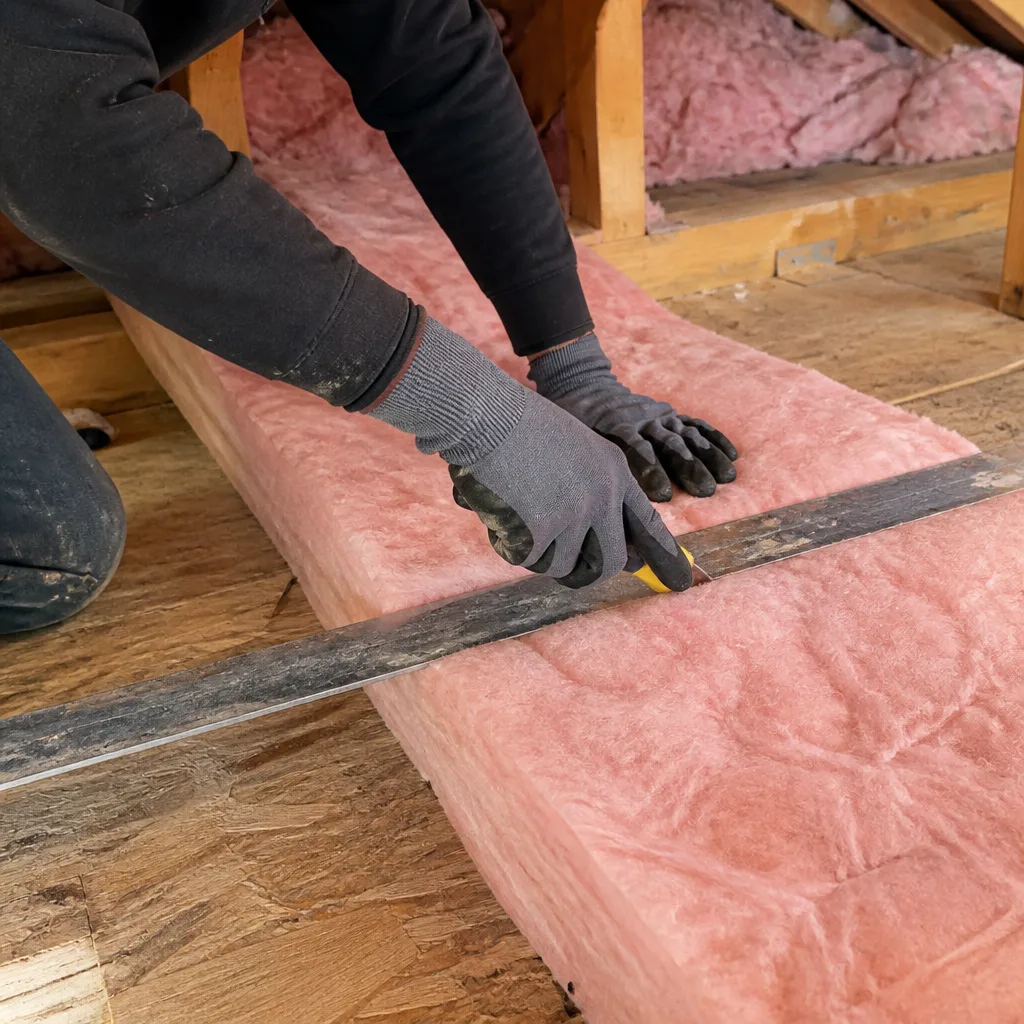
Insulation install or correction. We install or reinstall GreenFiber product to the specified depth and density, or apply the requested spray foam. On verified zones, we note installed R-value by location.
- 6
Post-installation blower-door test and documentation. We run the second blower-door test, record the new ACH50, and hand you a printed report with both numbers, a photo log of every sealed location, and the installed R-value map. That is what leaving looks like.
What GreenFiber Spray Foam Insulation Costs in Chicago
Most GreenFiber spray foam insulation jobs in Chicago fall into these ranges:
- Rim joist spray foam (typical 1,200 to 1,800 sq ft home): $1,800 to $3,200
- Garage ceiling spray foam (open-cell, 400 to 600 sq ft): $1,400 to $2,600
- Attic floor air seal plus GreenFiber loose-fill top-up to R-49/R-60: $2,200 to $4,100
- Spray foam roof deck (unvented attic, 2,000 sq ft roof, open-cell): $6,500 to $9,800
- Full second-floor knee wall spray foam plus dense-pack behind kneewalls: $3,800 to $6,400
What moves the price: access (a Chicago attic with a scuttle hole versus a full staircase), how much existing insulation must be pulled back or removed, whether rim joist access means cutting drywall or working from a crawl space, and the square footage of the roof deck or wall assemblies. You will get a written price before anything starts. Estimates are free. Call (218) 261-7714 and we will schedule the blower-door test and the written scope at the same visit.
Why Chicago Homeowners Call Topside Attic Insulation for GreenFiber Work
We are the only insulation contractor in Chicago that treats air sealing as a hard prerequisite rather than an upsell, and we publish the before-and-after blower-door numbers on every job where the test is applicable. That means you get a CFM50 or ACH50 reading before we start and after we finish, printed on the same sheet with the installed R-values and the photo log. If the numbers do not move, we say so. Under The Haven Standard, every job begins with a written price and ends with a documented record – no exceptions. Our technicians are background-checked and uniformed. A live person answers the phone 24/7, not a voicemail loop. And because we work with Owens Corning, Johns Manville, Knauf, Rockwool, CertainTeed, Icynene, Demilec, GreenFiber, and Reflectix, we are not anchored to one product line. If a Reflectix radiant barrier or closed-cell foam from another manufacturer is the better fit for your Chicago attic or rim joist, we will tell you that.
FAQs
Yes. Every job we complete in Chicago carries our 365-Day Done Right Promise: if it is not done right, we make it right. The scope of work, the warranty terms, and the before-and-after blower-door readings are printed and handed to you before we leave. Call (218) 261-7714 with any questions.
In most cases, yes. We stock or can source GreenFiber loose-fill, dense-pack, and spray-applied product, and we match fiber size and density to what is already in your attic or walls. If GreenFiber has changed a formulation or the existing product is degraded, we will tell you and recommend a compatible replacement rather than mixing incompatible materials.
Topping off is almost always cheaper, unless the existing GreenFiber has been wet, rodent-soiled, or compressed below effective R-value. We give you a straight answer based on what the thermal scan and a visual inspection show, not on what is more profitable for us.
We schedule most Chicago GreenFiber jobs within five to seven business days. Emergency rim joist sealing in freezing conditions can often be scheduled faster. A live person answers (218) 261-7714 24/7.
Yes. About a third of the GreenFiber jobs we see in Chicago are corrections. We document what we find with photos, give you a written scope for the fix, and run a blower-door test before and after so you can verify the change in a single number. If you have a competing written estimate, we will read it with you and give a free second opinion.
Written by Wes Okafor, Owner & Lead Building Envelope Technician, Topside Attic Insulation at Topside Attic Insulation, serving Chicago and nearby areas.