
Knauf Attic Insulation: The Chicago Owner’s Guide
If you’re looking for Knauf attic insulation in Chicago, here’s the direct answer: we stock Knauf EcoBatt and Knauf Jet Stream blown-in fiberglass on our trucks, and most Chicago attic insulation jobs in a standard 1,200 to 1,800 square foot attic run between $2,400 and $4,800 installed, including air sealing before any material goes in. We can typically have a crew on site within 48 to 72 hours of your written estimate, and we carry Knauf products specifically because they hold their R-value in Chicago’s humidity swings better than some budget alternatives. Most homeowners discover their Knauf insulation has failed not by looking at it, but by noticing their upstairs bedroom is suddenly five degrees warmer in July, or by seeing a ComEd bill in February that’s $120 higher than the same month last year.
Here’s what we’ve learned insulating attics across Chicago since 2016: the product matters less than what happens before it goes in. A Knauf batt installed over a leaky top plate is doing half its job. We seal first, then insulate. The blower-door numbers tell the truth about it.
Which Knauf Models This Applies To
Knauf makes two insulation lines we work with regularly in Chicago attics: EcoBatt (fiberglass batts and rolls) and Jet Stream (loose-fill blown fiberglass). EcoBatt comes in R-13, R-19, R-30, and R-38 faced and unfaced batt configurations, sized for 16-inch and 24-inch on-center framing. Jet Stream is the loose-fill option, rated at R-13.1 per inch when blown at the manufacturer’s specified density.
The compatibility gotcha we see constantly: Knauf R-30 batts are 9.5 inches thick, but many Chicago homes built before the 1980s have 2×8 ceiling joists that are only 7.25 inches deep. You cannot compress an R-30 batt into a 2×8 cavity and expect R-30 performance. The math doesn’t work that way. We carry both batts and blown-in options because the right choice depends on your joist depth, the condition of existing insulation, and whether you have can lights or knob-and-tube wiring that requires a clearance buffer. For most Chicago attics, we spec Jet Stream blown to R-49 covering the attic floor, with EcoBatt used only in specific soffit and knee-wall applications.
One honest clarification: Topside Attic Insulation is an independent insulation contractor. We are not affiliated with Knauf. We stock their products because the density and compression-resistance specs hold up, but we also source from Owens Corning, Johns Manville, Rockwool, and CertainTeed. No proprietary lock-in here; if another material performs better for your specific attic, we’ll say so and give you the price difference.
Signs Your Knauf Attic Insulation Is Failing
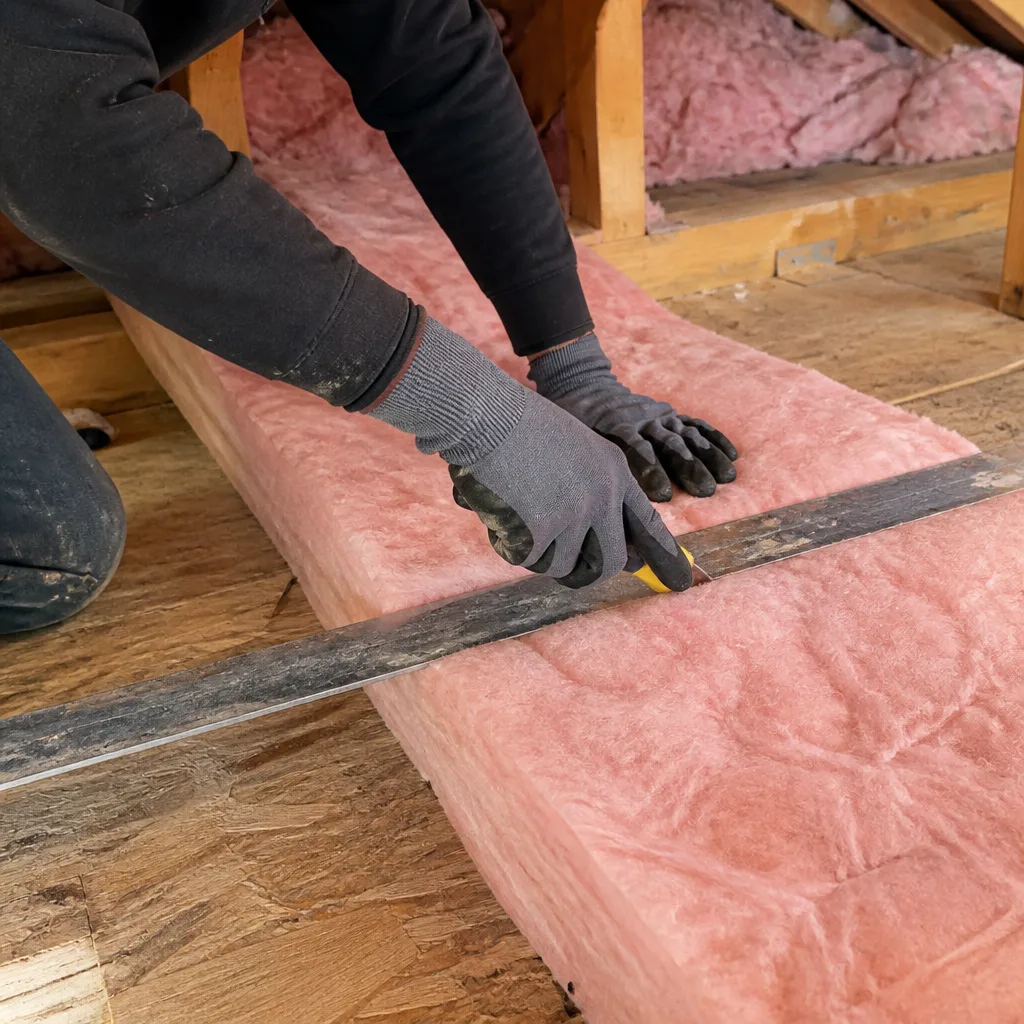
- Upstairs rooms won’t hold temperature. When Knauf batts get compressed (usually from storage boxes piled on top, or from a contractor walking through repeatedly), they lose their air pockets, and R-value drops with them. We measure attics in Chicago’s bungalow belt where R-38 batts are doing R-19 work because they’ve been flattened.
- Ice dams forming on the roofline in winter. Heat escaping through thin or settled insulation melts snow on the roof, which refreezes at the eaves. If you see icicles in January on one side of the roof but not the other, that’s a thermal bypass, not a gutter problem.
- You can see bare spots or gaps at the eaves. On a sunny day, go to the middle of the attic and look at the outer 24 inches. If you see roof sheathing between the insulation and the exterior wall, you’ve got wind washing and insufficient depth at the most vulnerable spot in a Chicago attic.
- Dust and fiberglass particles drifting into the living space. Knauf products are low-dust by design, but when there’s a pressure imbalance, airborne fibers get pulled through ceiling penetrations. Chronic dust on bedroom furniture below the attic access is a red flag.
- Second-floor humidity that climbs every summer. A failed or missing vapor retarder on faced Knauf batts lets humid exterior air migrate into the building cavity. In Chicago, where July dew points routinely hit 70°F, that moisture condenses somewhere it shouldn’t.
Replacement Cost & What’s Included
On a typical Chicago single-family home with a 1,400 square foot attic, expect $2,400 to $3,800 for full removal of failed insulation, air sealing of top plates, can lights, and penetrations, then re-insulating with Knauf Jet Stream blown to R-49. Larger homes push toward $4,800. Partial topping-off, where the existing Knauf insulation is still performing and you just need depth, runs $900 to $1,600 for adding 8 to 10 inches.
What drives the range: how much old material has to come out (attic cleaning runs $400 to $900 depending on debris and rodent activity), the number of can lights requiring sealed covers, and whether we need to add baffles at the eaves to prevent wind washing. Every quote includes the parts, the labor, the air sealing, the disposal of old material, and the blower-door readings before and after. You get a written price before any work starts, under Haven Standard Clause 1. No verbal figure, no “we’ll see when we get in there.” The written scope is the number.
DIY or Call Us?
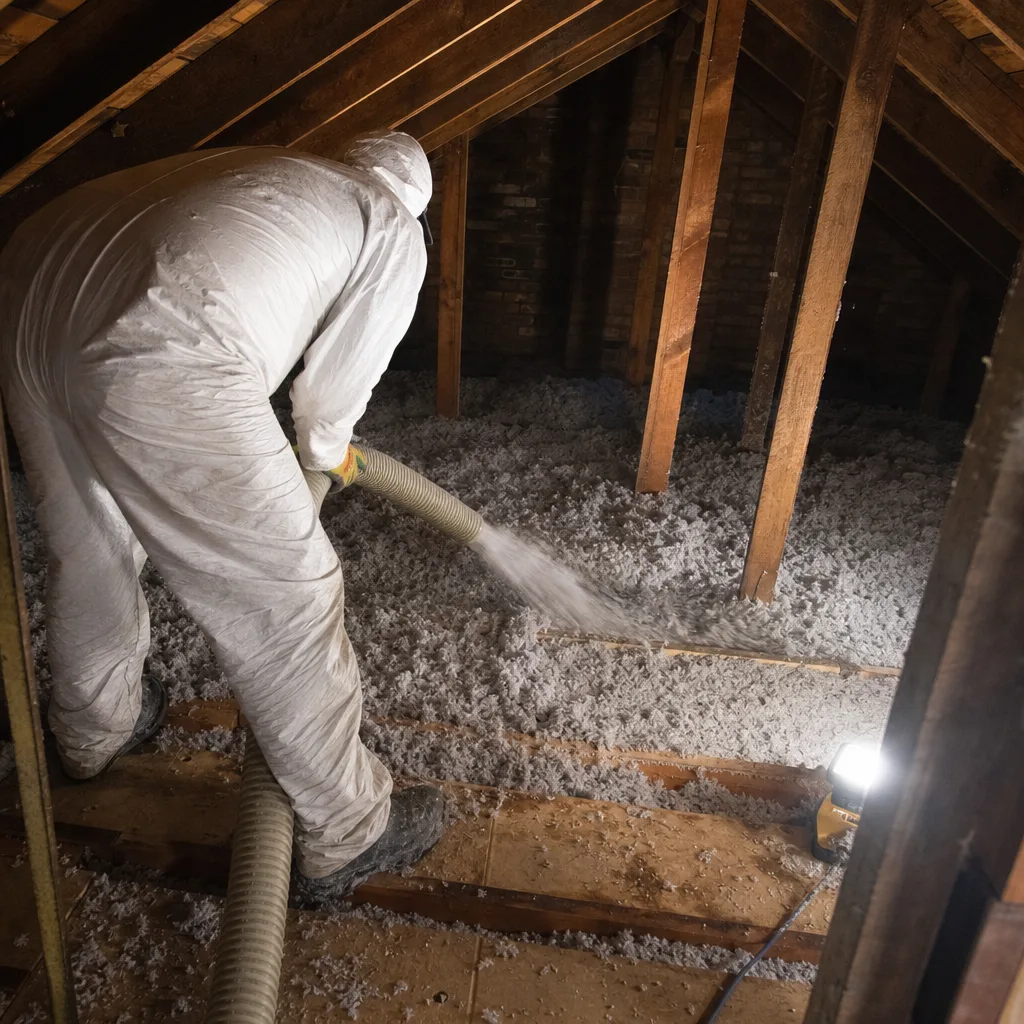
What you can safely check yourself: look at the insulation depth with a tape measure, note if batts are compressed or missing at the eaves, and photograph what you see through the attic hatch. That’s useful information before we arrive. What goes wrong with DIY: renting a blower machine and installing Knauf loose-fill without air sealing first means you’ve spent a weekend and $600 to blow insulation over a leaky attic floor. The conditioned air still escapes. You just can’t see where.
There’s an honest safety note here too: working in a Chicago attic in August means surface temperatures over 130°F, and kneewall work means navigating joists while carrying material. We wear respirators for fiberglass work, and we’ve seen enough blown-in dust up close to say the mask is not optional. If you want to do a visual inspection, that’s safe with gloves and a dust mask. If you want it fixed right, the phone number is (218) 261-7714.
FAQs
Knauf fiberglass insulation, whether batt or blown-in, has a functional lifespan of 40 to 60 years under ideal conditions, but in Chicago attics the real-world performance lifespan is often 15 to 25 years before air leaks, compression, settling, and rodent activity degrade it enough to matter. The insulation itself doesn’t rot or break down chemically; what fails is the installation environment around it. Call (218) 261-7714 and we’ll do a blower-door test and tell you exactly how your attic is performing.
If the Knauf material is dry, uncompressed, and pest-free, you can top it off with additional blown-in insulation to reach R-49 without full removal. If it’s been wet, matted with rodent droppings, or compressed below 60% of its original thickness, replacement is the honest call, because adding material on top doesn’t restore the lost performance underneath. We’ll tell you which situation you have after one inspection.
A typical full removal, air sealing, and re-insulation on a Chicago home takes one day, with a crew of two arriving by 7:30 AM and finishing by 3:00 PM; larger homes with extensive rodent remediation or multiple can light retrofits may run a second morning. Before-and-after blower-door readings add about 30 minutes total and are included. We tell you the exact timeline in the written scope before you sign anything.
We keep Knauf EcoBatt R-19, R-30, and Jet Stream loose-fill in stock at our Chicago yard, so most jobs don’t wait on a distributor delivery. If your attic needs a specific Knauf product we don’t have on hand, we’ll order it and schedule around the lead time, which is typically three to five business days. Text us at (218) 261-7714 and we’ll confirm stock the same day.
Written by Wes Okafor, Owner & Lead Building Envelope Technician, Topside Attic Insulation at Topside Attic Insulation, serving Chicago and nearby areas.