
Rockwool Crawl Space Encapsulation: The Chicago Owner’s Guide
Rockwool-compatible crawl space encapsulation in Chicago typically runs $4,800 to $11,500 installed for a standard 900 to 1,400 square foot crawl space, and our crews can usually start within five to seven business days. If you’re here because the vapor barrier has torn, pulled away from the foundation walls, or the Rockwool batts have absorbed moisture and slumped, you’ve found the failure point: Rockwool’s stone wool resists water but its performance collapses once the encapsulation layer behind it fails, because Chicago’s clay soil pushes moisture up through the slab from March through June. We stock Rockwool Comfortbatt and Safe’n’Sound on our trucks, along with 12-mil and 20-mil reinforced poly vapor barrier, butyl tape, and mechanical fasteners sized for Chicago’s common limestone and poured-concrete foundations.
Here’s what you need to know before you spend another dollar: the Rockwool itself rarely fails first. What fails first is the barrier system around it, and once that happens, the Rockwool becomes a moisture sponge that holds water against your rim joists and floor framing. We’ll walk you through what to look for, what it costs, and what actually fixes it so you’re not re-encapsulating the same crawl space in four years.
Which Rockwool Models This Applies To
The Rockwool products we work with in crawl space encapsulation are Comfortbatt R-15 and R-23, Safe’n’Sound, and Comfortboard 80. Comfortbatt is a semi-rigid batt designed to friction-fit between framing members; Comfortboard 80 is a rigid board rated for continuous exterior insulation and below-grade contact. The critical compatibility factor: Comfortbatt in a crawl space must sit against a dry, intact vapor barrier. Rockwool does not manufacture the barrier itself, so what you’re really diagnosing is whether the poly layer, the mechanical attachment points, and the perimeter seal have held up under Chicago’s specific conditions.
How to identify the right replacement material: Comfortbatt is labeled by R-value and measures 15 or 23 inches wide to fit standard framing bays. Comfortboard 80 is labeled by thickness, typically 1.5 or 2 inches, and it’s the one we use when a crawl space wall needs insulation plus a water-shedding layer. If you’re looking at a part that feels like a fiberglass batt, it isn’t Rockwool; Rockwool is denser, darker, and does not compress the way fiberglass does. One gotcha we see repeatedly: homeowners replace Comfortbatt batts without fixing the vapor barrier behind them, then call us a year later with the same sagging insulation and the same musty smell.
The OEM-vs-aftermarket question is straightforward here. Rockwool does not make a dedicated encapsulation “kit.” What you’re buying is a materials assembly: vapor barrier, fasteners, seam tape, and Rockwool batts or boards. Knockoff stone wool products exist online, but their density and fire resistance are not the same spec, and in a crawl space that doubles as a mechanical chase, that matters. We source Rockwool directly, along with reinforced poly from established manufacturers. We’re an independent contractor and not affiliated with Rockwool, which means we can also use Owens Corning or Johns Manville equivalents when the job calls for it, but we don’t swap materials without a written price line item that names the product.
Signs Your Rockwool Crawl Space Encapsulation Is Failing
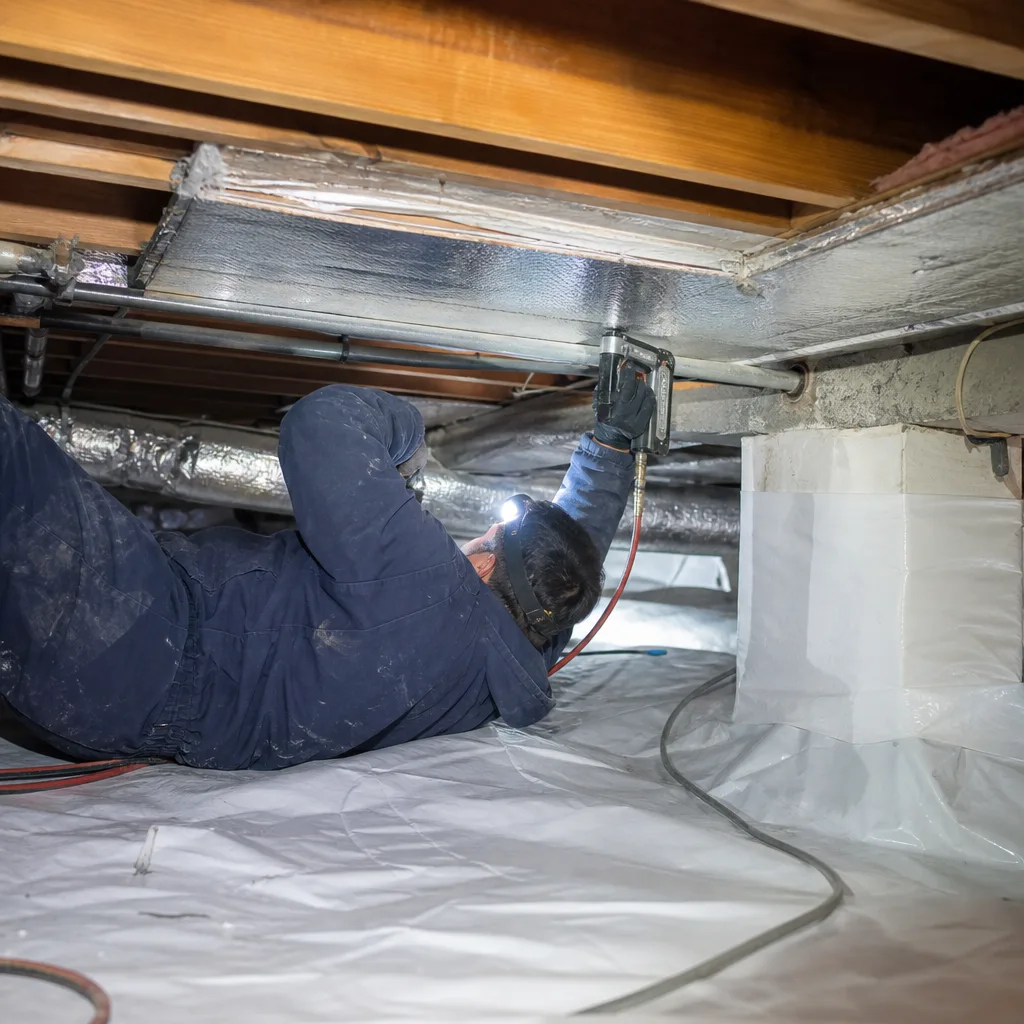
Owners usually find the problem during a routine check, not because something catastrophic happened. Here’s what we see most often in Chicago, from Rogers Park to Beverly to Edison Park:
- Batts are sagging or on the floor. This means the vapor barrier behind them failed, moisture wicked into the stone wool, and the added weight broke the friction fit. The insulation is now doing nothing except holding water against your joists.
- Barrier seams have separated or pulled away from walls. In Chicago, foundation settlement shifts things seasonally. When the poly pulls off the wall, ground moisture enters the space, and your Rockwool becomes the filter that traps it.
- Musty smell you can smell through the first-floor registers. That smell is a result of biological growth feeding on organic dust trapped in damp insulation. Even hydrophobic stone wool can host surface growth when it stays wet for months.
- Condensation on ducts or copper pipes in the crawl space. That tells you the relative humidity in the space has climbed above 60%, which is the threshold where mold, rot, and floor-finish problems begin.
- Cold floors in winter or higher gas bills with no other explanation. Once the encapsulation barrier fails, the stack effect pulls cold, wet air up through the floor assembly. Your furnace works harder, and the floors never feel warm.
Replacement Cost & What’s Included
For a typical Chicago crawl space between 900 and 1,400 square feet, a full Rockwool-compatible re-encapsulation runs $4,800 to $11,500 installed. At the lower end: replacing torn sections of 12-mil vapor barrier, re-taping seams, re-securing the perimeter, and reinstalling R-15 Comfortbatt in the rim joist bays. At the higher end: full barrier replacement with 20-mil reinforced poly, R-23 batts or 2-inch Comfortboard 80 on foundation walls, spray-foam rim joist treatment to handle Chicago’s stack effect, and a dehumidifier sized for the space. The price difference comes down to square footage, access height (crawl spaces under 30 inches take longer), whether the old material must be removed, and whether mold remediation is required before anything new goes in.
Every Topside Attic Insulation quote is a written line item: material, labor, disposal, and any access work. No allowances, no “we’ll see what we find.” If the blower-door test applies to your home, we’ll include before and after numbers on the report. All completed work falls under our 365-Day Done Right Promise: if it’s not done right, we make it right.
DIY or Call Us?
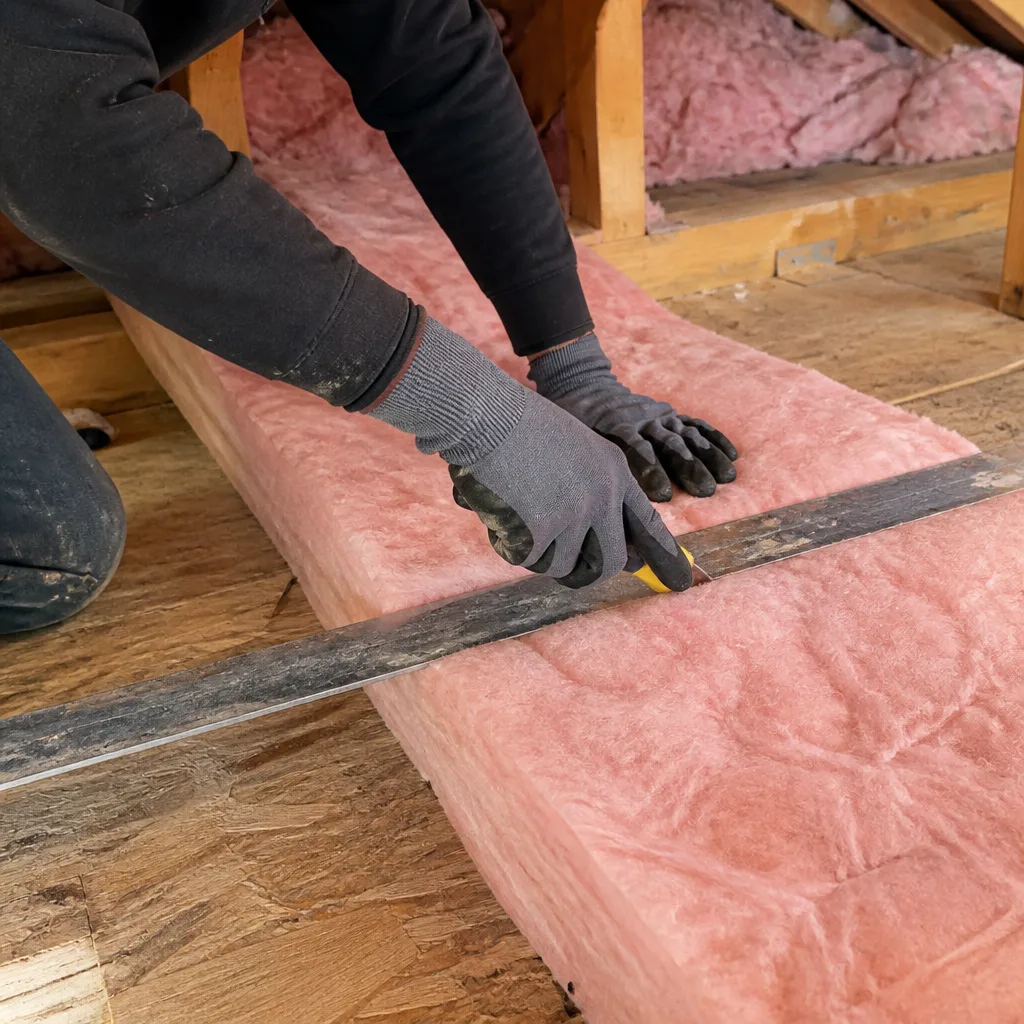
You can safely diagnose most of these failures yourself: stick your head in the access hatch with a flashlight, look for water staining on the concrete, drooping poly, and batts that have fallen. That’s not dangerous. What’s less safe is spending a weekend in a 30-inch crawl space reattaching poly against a wet foundation wall while breathing confined air, and what’s truly easy to get wrong is sealing the foundation-to-sill joint correctly. That seam is where Chicago’s wind-driven air infiltrates, and if it’s not sealed and mechanically fastened, your new Rockwool fails again inside two winters. We also handle the disposal: wet insulation weighs more than homeowners expect, and Chicago’s waste rules on construction debris vary by hauler.
If you want a professional diagnosis with pressure-test numbers, or you just don’t want to spend Saturday on your back in a crawl space, call us at (218) 261-7714. We’ll put the scope in writing before anything starts.
FAQs
A properly installed vapor barrier with Rockwool insulation typically lasts 15 to 25 years in Chicago, but the barrier should be inspected every three years because Chicago’s freeze-thaw cycles and clay soil put constant stress on foundation attachments. Call (218) 261-7714 if you’re seeing signs of barrier separation in your crawl space.
Yes, if the barrier has localized tears and the Rockwool is still dry, we can section-repair with seam tape and mechanical fasteners and re-install the same batts. If the Rockwool has been wet for more than a season, replacement is cheaper long-term. Call (218) 261-7714 for a written assessment.
Most Chicago crawl space re-encapsulations take one to three working days, depending on square footage, existing material removal, and whether rim joist air sealing is included. Call (218) 261-7714 to discuss your specific crawl space.
Yes, we stock Rockwool Comfortbatt R-15 and R-23, Safe’n’Sound, and Comfortboard 80 on our trucks, plus 12-mil and 20-mil reinforced vapor barrier and the mechanical fasteners Chicago foundations require. We also stock Reflectix for radiant barrier applications when a home calls for it. Call (218) 261-7714 to confirm availability for your job.
Get a Written Price Before Work Starts
If your Rockwool crawl space encapsulation has failed, the fastest way to a real number is to call (218) 261-7714. A live person answers, and we’ll schedule an inspection. Every job starts with a written price and a written scope, and it ends with a documented photo record and before-and-after blower-door numbers on applicable jobs. That’s how it works under The Haven Standard since 2016.
Written by Wes Okafor, Owner & Lead Building Envelope Technician, Topside Attic Insulation at Topside Attic Insulation, serving Chicago and nearby areas.